

Pause on error
Pause-on-error is armed by default. You do not set it up. The first time a node throws with a debugger attached, the run stops right there — before the framework sees the error, before a retry loop swallows it, before the model gets to invent a recovery.
This is the workflow that makes GraphMind worth attaching.
Why “in place” matters
Section titled “Why “in place” matters”An agent that throws inside a tool usually does one of three unhelpful things: it retries with the same bad input, it feeds the error text back to the model which apologises and tries something else, or it dies three frames later with a stack that says nothing about the cause.
By the time a trace reaches you, all of it is past tense. Pause-on-error freezes the moment:
- the arguments the model actually passed, not a summary;
- the error as thrown, with its stack;
- the rest of the run, still ahead, still changeable.
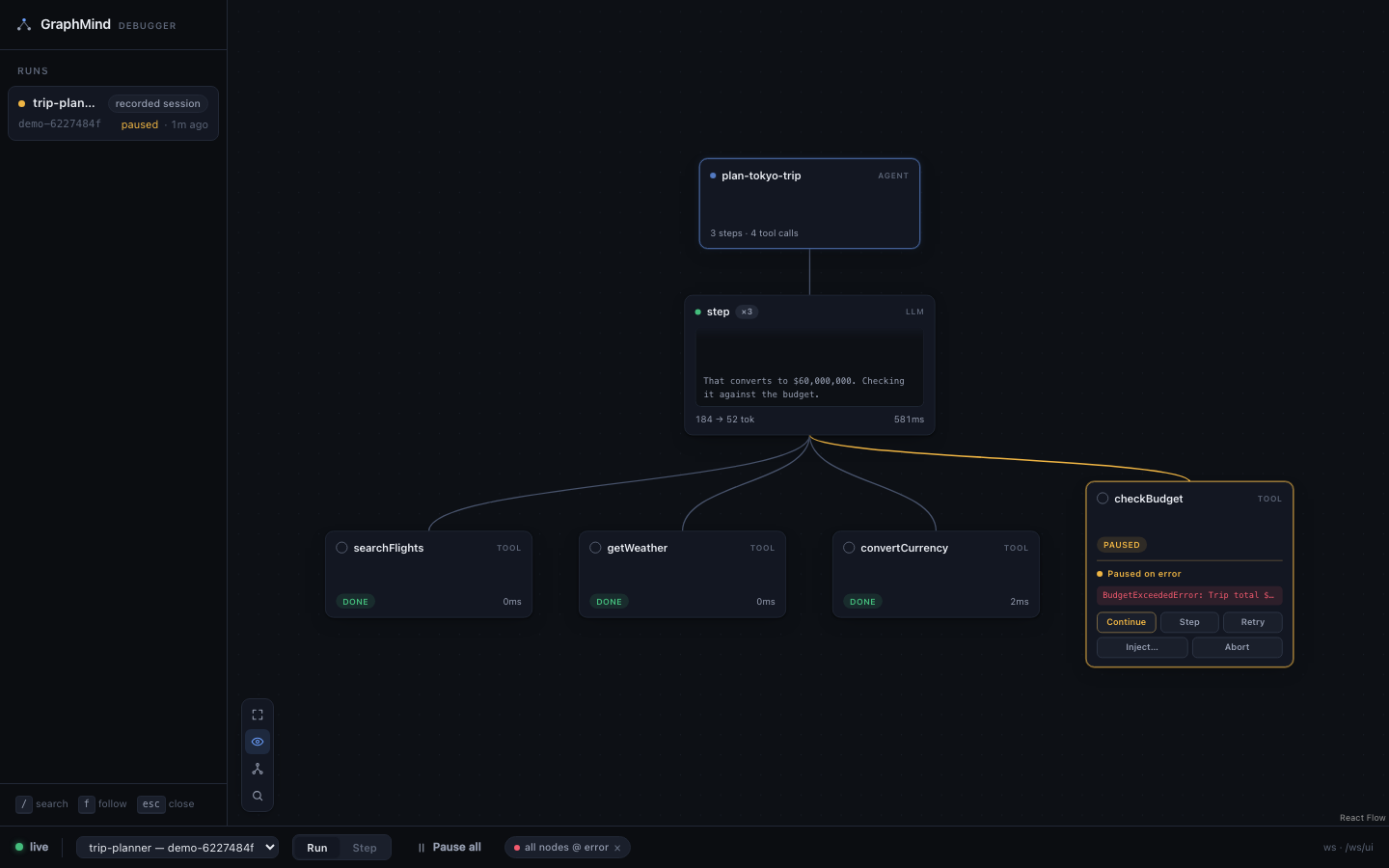
The loop
Section titled “The loop”-
Run the debugger and your agent.
graphmindin one terminal, your app in another. Nothing else to configure. -
Wait for the stop. The node turns red, a pause banner appears on it, and the run bar shows the run as held. Nothing is in flight — no socket is open burning a timeout, so you can take as long as you like.
-
Read the state. Open the inspector on the paused node: input, the error name, message and stack, and the outputs of everything upstream that got you here. ⇧E dims everything that is not an ancestor of the failure. See inspecting a run.
-
Decide.
Action Use it when continueYou want the original error to propagate — the framework handles it from here retryThe failure was transient, or you fixed something outside the process injectYou know what the call should have returned — supply it and move on abortThis run is a write-off; stop it cleanly without a retry storm -
Watch the rest. The run resumes from exactly that point. No restart, no re-billing the tokens you already spent.
What each action does to your code
Section titled “What each action does to your code”The adapter — not the viewer — implements these, and the semantics are precise:
continuerethrows the original error. In the Vercel AI SDK that means the SDK serialises it as an error tool-result and the agent loop keeps going, exactly as if GraphMind had not been there.retryre-invokes the originalexecutewith the same arguments. Useful for a flaky HTTP call, or after you have fixed the world (started the database, refreshed the token).injectswallows the error and returns the value you typed as the tool’s result. The model sees a success. This is how you test a recovery path in seconds — see inject and continue.abortaborts the run’sAbortControllerwith anAbortError-named reason. SDK retry logic treatsAbortErroras terminal, so the run stops instead of retryingmaxRetriestimes on the way out.
Turning it off
Section titled “Turning it off”Pause-on-error is a breakpoint like any other: a matcher of { point: 'error' }. The viewer
shows it as a removable chip in the run bar — clear the chip and errors flow straight through
while everything else stays live.
If the debugger goes away
Section titled “If the debugger goes away”Fail-open is absolute. If you close the viewer, kill the server, or your laptop sleeps while a gate is held:
- every held gate resolves
continuewithin 100 ms (packages/client/test/session.test.tsandpython/tests/test_failopen.pyassert it); - breakpoints and mode are forgotten until a new handshake re-arms them;
- your agent finishes as though nothing had ever attached.
An agent held at an error gate is never stuck because of GraphMind. The worst case is that it proceeds exactly as it would have without a debugger.
Try it right now
Section titled “Try it right now”npx graphmind-ai demoThe bundled recording plants a real bug: convertCurrency inverts an exchange rate, so the
budget check throws on an absurd total. It pauses for real, and all four actions steer the
replay onto the matching branch.